Published September 4, 2026
Microsoft Ads vs Google Ads: Cost, Competition, and Bot Traffic (2026 Data)
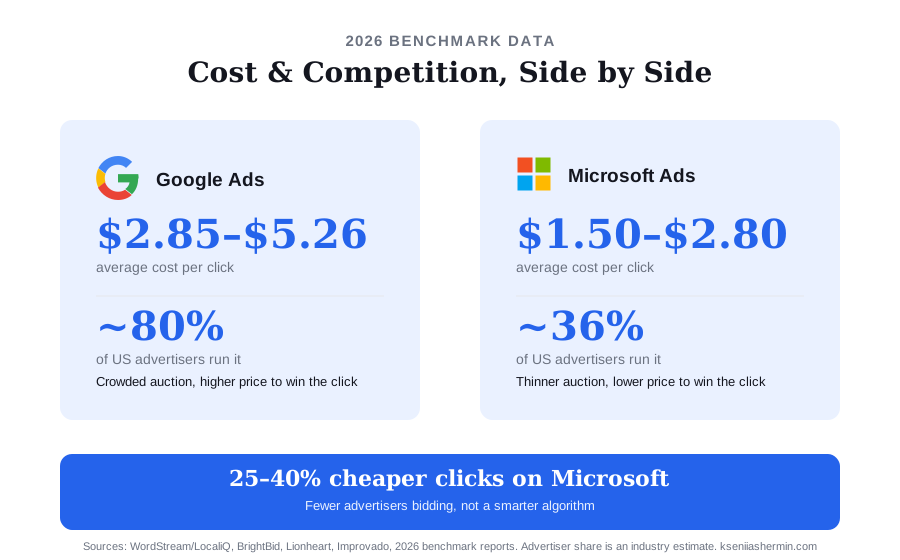
Microsoft Ads costs 25 to 40 percent less per click than Google Ads on average, mainly because far fewer advertisers bid there, and its cost per conversion runs about 31 percent lower across most industries. Google still converts at a higher rate overall and dominates on raw search volume. Neither platform wins outright. Microsoft wins on efficiency, Google wins on scale, and the platform with less competition also carries a traffic-quality risk that Google advertisers rarely have to think about.
I’ve managed millions of dollars in Google Ads and Microsoft Ads budgets side by side, and I’ve watched this tradeoff play out in real accounts for over ten years. Here is what the 2026 benchmark data shows, what running both platforms for a decade has actually taught me, and where the cheaper platform starts costing you more than it saves.
Quick Comparison (2026 Benchmarks)
Google Ads
Microsoft Ads
Numbers above are blended from multiple 2026 industry benchmark reports (WordStream, BrightBid, Lionheart, NaMedia Experts, Whatagraph, Improvado). Treat them as directional, not exact. Your own account data will vary by industry and competitiveness, and the advertiser-participation figure in particular is an industry estimate rather than a platform-reported number.
Why Microsoft Ads Is Cheaper: Fewer Advertisers, Smaller Auction
The gap comes down to one thing: fewer advertisers bid on Microsoft Ads, so the auction is less crowded. Industry estimates put US advertiser participation at roughly 80% for Google Ads versus 36% for Microsoft Ads. That is the entire mechanism behind the price difference. It is not that Microsoft’s algorithm is smarter or its targeting more precise. Less competition for the same keywords means a lower price to win the click.
The size of the discount varies a lot by industry. Some benchmark data shows the gap widening past 40% in categories like careers and employment, hospitality, and B2B software, and narrowing closer to parity in the most Microsoft-saturated consumer categories. B2B and legal tend to show some of the widest gaps, since Google’s auction in those categories is especially dense.
This is also the reason I tell clients not to treat Microsoft Ads as a smaller, cheaper copy of their Google account. A thinner auction changes how you should think about bids, match types, and budget pacing, not just how much you pay per click.
The Conversion Rate Gap Is Smaller Than the CPC Gap
This is the part people miss. Google’s cross-industry conversion rate sits around 8.18%, while Microsoft’s blended average is closer to 3.5%. That sounds like a big gap. But it is not evenly distributed. Microsoft’s strongest verticals, careers and employment, finance and insurance, and real estate, land in the 5 to 7% range, within a few points of Google. In some categories, notably home services and hospitality, Microsoft has actually converted at a higher rate than Google, because the audience is more deliberate and the auction has less low-quality competition diluting it.
The practical takeaway: a 25-40% lower CPC combined with a conversion rate that is close, or in some verticals better, is what drives Microsoft’s real advantage, which shows up most clearly in cost per conversion rather than CPC alone.
Cost Per Conversion: Where Microsoft Actually Wins
Cost per conversion on Microsoft Ads runs about 31% lower than Google’s on average across comparable industries, according to WordStream’s cross-platform conversion cost data. Reported per-conversion costs on Microsoft range from around $15 in hospitality up to $73 in legal, tracking lower than Google’s equivalent figures in the same categories.
This is the number that should actually drive budget decisions, not CPC in isolation. A cheaper click that converts at a much lower rate is not a win. A cheaper click that converts close to parity is.
The Other Side of Cheaper: Bot Traffic and Invalid Clicks
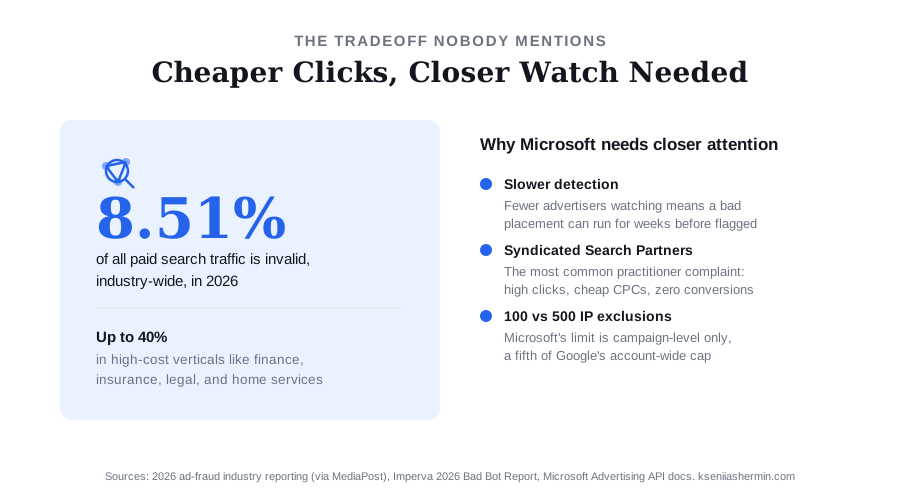
Here is what most Microsoft Ads pitches leave out. A less crowded auction is also a less scrutinized one, and that matters because invalid traffic is not a small problem on paid search generally. Across the industry, an estimated 8.51% of all paid ad traffic in 2026 is invalid, roughly one in every twelve clicks, amounting to an estimated $63 billion in wasted global ad spend. Programmatic traffic runs even higher, around 20.6% invalid, and in high-cost verticals like financial services, insurance, legal, and home services, invalid traffic can reach as much as 40% of clicks.
Microsoft does not publish a platform-specific invalid-traffic rate the way some ad-fraud vendors benchmark other networks, so there is no clean “Microsoft is X% worse than Google” number to point to. What I can tell you from running accounts on both platforms is that the structural risk is real and it is not the same risk you manage on Google:
- Fewer advertisers watching means bad traffic runs longer before anyone flags it. Google’s auction has so many advertisers competing for the same placements that a bad publisher gets reported and excluded fast, often collectively. On Microsoft’s smaller advertiser base, a low-quality placement can keep serving clicks for weeks before enough people notice the pattern.
- The Syndicated Search Partners network is the most common complaint I see from other PPC practitioners, and I’ve seen it myself: high click-through rate, cheap CPCs, and zero conversions from a placement, the classic signature of non-human or low-intent traffic. It is worth testing “Bing and Yahoo! search (owned and operated) only” against the default broader syndication setting for lead-gen accounts where cost per qualified lead matters more than volume.
- Microsoft’s own IP exclusion tooling is tighter than Google’s. You get 500 IP exclusions per campaign on Google Ads. On Microsoft Ads, the limit is 100 IP addresses or ranges, and the list lives at the campaign level only, there is no account-wide list. That makes it slower to lock down a bad IP range across an entire account.
None of this means Microsoft Ads is not worth running. It means it needs closer, more frequent attention than a Google account does, not less, even though the cost per click is lower.
How I Keep a Microsoft Ads Account Clean
A few habits I apply to every Microsoft Ads account I manage, on top of what I already do on Google:
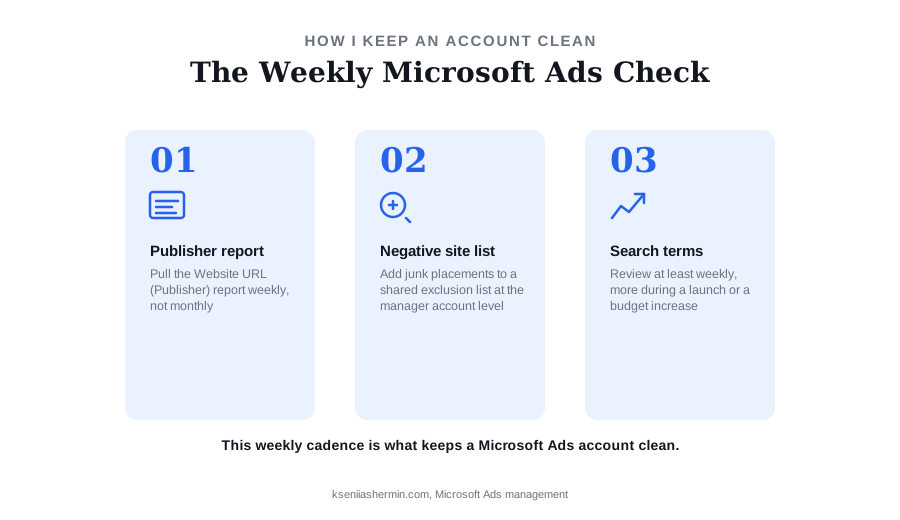
- Pull the Website URL (Publisher) report weekly, not monthly. This is the report that shows exactly which placements on the Audience Network and Syndicated Search Partners served your ads. On Google, I can often get away with a lighter cadence. On Microsoft, weekly is the minimum, because low-quality placements get more expensive to clean up the longer they run.
- Update the negative site list on a schedule, not reactively. Microsoft lets you build up to 5,000 negative sites per exclusion list, up to 10,000 total per list, and up to 3 shared lists per manager account that you can apply across every ad account underneath it. Build that shared list once, then keep adding to it as new junk placements show up, instead of rebuilding exclusions account by account.
- Review search terms more often than you would on Google. Microsoft’s match-type broadening and its syndicated-partner query matching introduce more noise into the search terms report than Google’s does in my experience. I check search terms on Microsoft at least weekly on active lead-gen accounts, sometimes more often during a launch or a budget increase, and convert obvious junk into negative keywords immediately rather than batching it.
- Test the network setting, don’t assume the default is right for you. Restricting delivery to Bing and Yahoo search (owned and operated) only, versus the default that includes syndicated partners, is a real lever. It is not right for every account, some verticals get legitimate volume from the wider network, but I test it rather than leaving the default in place unexamined.
The short version: treat Microsoft Ads traffic quality as something you actively manage every week, not something you check when performance looks off. The lower cost per click is real, but it is not free money, it is a platform that rewards closer attention than Google does.
Audience: Why the Numbers Look the Way They Do
Microsoft Ads traffic skews older, more affluent, and more desktop-heavy than Google’s. That audience profile is a large part of why B2B, financial services, and professional services categories tend to see some of the strongest relative performance on Microsoft. It is also why hyper-local, mobile-first, or under-25 audiences tend to see a thinner and less reliable picture on the platform, since Microsoft’s reach there is comparatively weak.
Microsoft’s reach also extends beyond Bing itself, into Yahoo, AOL, DuckDuckGo, Ecosia, MSN, Outlook, and increasingly Copilot, which Microsoft reports now serves more than 320 million monthly users. That expanding AI-driven inventory is part of what is shifting auction dynamics on the platform going into 2026 and beyond.
When the Data Says to Shift Budget to Microsoft
- Your industry shows a wide CPC gap and a narrow conversion rate gap in the benchmark data (B2B, finance, real estate, careers, legal)
- Your buyer skews older, higher income, or desktop
- You have the bandwidth to actively manage a second platform, including weekly placement and search term review, rather than set it and forget it
- Your Google Ads account is already profitable and you are looking for incremental volume at a better cost per conversion
When to Stay Cautious
- Your Google Ads account is not yet profitable. Fix that first before adding a second platform to manage
- Your audience is heavily mobile or under 25, where Microsoft’s reach is thin
- You do not have time to monitor placement quality and search terms closely on a second platform, since Microsoft needs more of that attention than Google does, not less
What This Looks Like In a Real Account
In one national US services account I managed, running both platforms side by side:
Google Ads
Microsoft Ads
$119 versus $167: Microsoft wins on cost per conversion by about 29%, despite converting at less than half of Google’s rate.
That gap is the whole thesis in one account. Google’s conversion rate is more than double Microsoft’s, real quality, a more deliberate searcher, a cleaner auction. But that quality comes from a crowded, competitive auction, and competition is exactly what drives the CPC up to $9.20. Microsoft’s click is 71% cheaper because far fewer advertisers are bidding on it, and even with a conversion rate less than half of Google’s, the cheaper click still wins on cost per conversion, $119 versus $167. Better quality on Google loses to lower competition on Microsoft once you look at the number that actually matters. It only wins because the account gets the weekly placement and search term attention described above, without that, a conversion rate this much lower than Google’s would have eaten the entire CPC advantage and then some.
Want This Managed For You?
I’ve managed millions of dollars in Google Ads and Microsoft Ads budgets side by side, over ten years. If your Google Ads account is already profitable and you’re weighing whether Microsoft is worth the extra platform to manage, or your Microsoft Ads account already exists but nobody has been watching the placements and search terms closely enough, that is exactly the kind of account I take on.
Get in touch about Microsoft Ads management, or see what’s included in an audit or ongoing management.
Sources
CPC, conversion rate, and cost-per-conversion benchmarks are drawn from 2026 reports by WordStream/LocaliQ, BrightBid, Lionheart, NaMedia Experts, Whatagraph, SearchLab, and Improvado. Invalid-traffic figures are drawn from 2026 ad-fraud industry reporting (via MediaPost) and Imperva’s 2026 Bad Bot Report. IP exclusion limits and negative-site-list capacity are drawn directly from Microsoft Advertising’s own API documentation (learn.microsoft.com). Figures vary somewhat between sources depending on methodology and account mix, where sources disagreed, a range is shown rather than a single average, and estimates without a platform-reported source are labeled as such.
What does the CPC gap and traffic quality look like in your own accounts? I’m always curious whether the industry averages, and the bot traffic risk, hold up once you’re actually in the data.
FAQ
Is Microsoft Ads cheaper than Google Ads?
Yes. Microsoft Ads averages 25 to 40 percent lower CPC than Google Ads, mainly because far fewer advertisers compete in its auctions, an estimated 36% of US advertisers versus roughly 80% on Google.
Does Microsoft Ads convert as well as Google Ads?
Not quite on average. Google's cross-industry conversion rate runs around 8.18%, versus roughly 3.5% blended on Microsoft. But the gap narrows sharply in specific verticals like finance, real estate, and careers, and in a few categories Microsoft actually converts higher than Google.
Is Microsoft Ads cost per conversion lower than Google's?
Yes, by about 31% on average across comparable industries, which is the metric that matters more than CPC alone when deciding where to allocate budget.
Does Microsoft Ads have a bot traffic problem?
Microsoft does not publish its own invalid-traffic rate, so there is no official platform-specific number. But the platform's smaller advertiser base means bad placements get flagged and excluded more slowly than on Google, and PPC practitioners commonly flag the Syndicated Search Partners network as a source of high-click, low-conversion traffic. Weekly publisher and search term reviews are the practical fix.
How often should I update my Microsoft Ads negative site list?
Weekly, on an active lead-gen account. Build a shared exclusion list at the manager account level, up to 5,000 sites per list and up to 10,000 per list total, so it applies across every account underneath it instead of being rebuilt account by account.
Should every advertiser run both Google Ads and Microsoft Ads?
Only once the Google Ads account is already profitable. Microsoft Ads works best as an incremental, lower-cost addition, not a replacement for a working Google Ads foundation, and it needs closer weekly attention to traffic quality than most Google accounts do.